
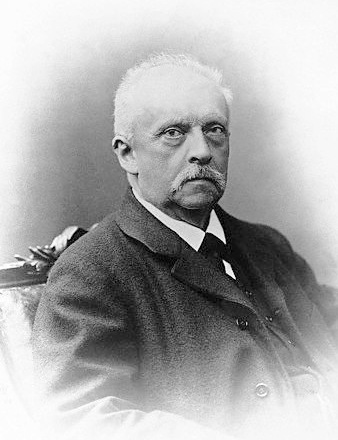
HELMHOLTZ, Hermann Ludwig Ferdinand von (1821 – 1894)
1821 – 1894
9 entries in the GMN corpus.
Image source Public domain
1847
#611
Ueber die Erhaltung der Kraft, eine physikalische Abhandlung.
An epoch-making work which led the way to the acceptance of the fundamental physical doctrine of the conservation of energy.
1848
#612
Ueber die Wärmeentwickelung bei der Muskelaction.
Helmholtz showed the muscles to be the principal source of animal heat.
1850
#1265
Vorläufiger Bericht über die Fortpflanzungsgeschwindigkeit der Nervenreizung.
Helmholtz succeeded in measuring the velocity of the nervous impulse, by applying the knowledge and techniques of ballistics to the problem. In 1852, using a pendulum-myograph of his own invention, he measured the dur…
1851
#5866
Beschreibung eines Augen-Spiegels zur Untersuchung der Netzhaut im lebenden Auge.
Invention of the ophthalmoscope, one of the greatest events in the history of ophthalmology. English translation by T. H. Shastid, Chicago, Cleveland Press, 1916.
1852
#1508
Ueber die Theorie der zusammengesetzten Farben.
1854 –1855
#1509
Ueber die Accommodation des Auges.
Helmholtz determined the optical constants and explained the mechanism of accommodation, with the help of the ophthalmometer which he had invented in 1852.
1863
#1562
Die Lehre von der Tonempfindungen als physiologische Grundlage für die Theorie der Musik.
Helmholtz’s theory of hearing, upon which all modern theories of resonance are based. This exhaustive study of acoustics ranks as one of the greatest books on the subject and shows that Helmholtz was, besides being a …
1867
#1513
Handbuch der physiologischen Optik. 1 vol. and atlas.
Includes Helmholtz’s revival of the Young theory of color vision. English translation by J.P.C. Southall of 3rd German edition, 3 vols., Menasha, Wis., 1924-25.
1868
#1563
Die Mechanik der Gehörknöchelchen und des Trommelfells.
Helmholtz’s study of the mechanism of the tympanum and ossicles of the middle ear did much to elucidate the phenomenon of audition. It includes a description of “Helmholtz’s ligament” of the malleus. Separate offprint…