
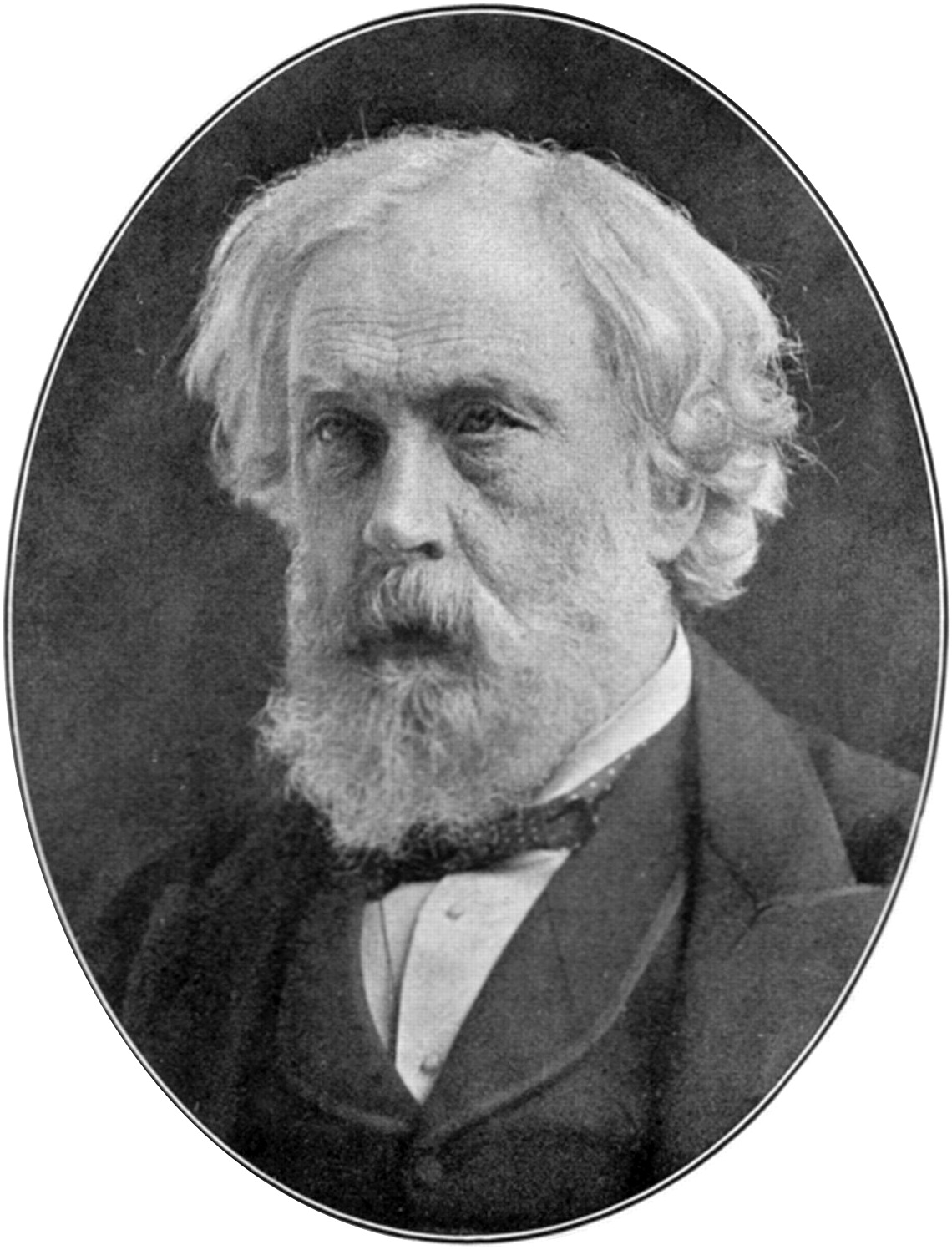
WILKS, Sir Samuel (1824 – 1911)
1824 – 1911
10 entries in the GMN corpus.
Image source Unknown author Unknown author · Wilks S. Biographical Reminiscences of Sir Samuel Wilks. London: Adlard & Son, 1911, reprinted in: MJ Eadie. Samuel Wilks (1824-1911): neurologist and generalist of the Mid-Victorian Era „J Med Biogr”. 416, ss. 215-20 (Nov 2008). doi:10.1258/jmb.2007.007042. PMID 18952992 . · Public domain
1856
#3764
Cases of a peculiar enlargement of the lymphatic glands frequently associated with disease of the spleen.
Wilks really put Hodgkin’s disease “on the map”; the second paper for the first time attached Hodgkin’s name to the disease
1861
#4052
A peculiar atrophy of the skin (Lineae atrophicae).
First description of lineae atrophicae.
1862
#4053
Disease of the skin produced by post mortem examinations, or verruca necrogenica.
Description of dissecting-room warts (verrucae necrogenicae),tuberculosis verrucosa cutis (also known as Lupus verrucosus, Prosector's wart, and "Warty tuberculosis"[ the cutaneous tuberculosis of Laennec, sometimes c…
1863
#2389
On the syphilitic affections of internal organs.
Wilks’s outstanding work was on visceral syphilis, a subject which he was one of the first to study.
1868
#4539
Drunkard’s or alcoholic paraplegia.
Classic account of alcoholic paraplegia.
1868 –1869
#4338
Case of osteoporosis, or spongy hypertrophy of the bones (calvaria, clavicle, os femoris, and rib).
A classic account of osteitis deformans. Wilks was associated with Guy’s Hospital all his life. A kindly, charming man, he was described by Osler as one of the handsomest men in London in his time, even until the age …
1869
#2678
On markings of furrows on the nails as the result of illness.
1870
#2769
Capillary embolism or arterial pyaemia.
One of the first accounts of bacterial endocarditis was given by Wilks, who, in his classic paper on the subject, called the condition “arterial pyaemia.” Reprinted in Willius & Keys, Cardiac classics, 1941, pp. 579-84.
1877
#4745
On cerebritis, hysteria, and bulbar paralysis, as illustrative of arrest of function of the cerebro-spinal centres.
The case of “bulbar paralysis” (pp. 45-55) is believed to be the first definite record of myasthenia gravis.
1892
#7496
A biographical history of Guy's Hospital.
Digital facsimile from the Internet Archive at this link.